COMPACT

COMPACT
Computer models such as FEM, CFD, SPICE, and ray tracing are widely used to analyze how changes in design and noise parameters affect the final product. However, using these models for design optimization is not always straightforward because:
- A single simulation can take hours to run.
- There are often many different design (input) and product performance (output) parameters.
- The relationships between input and output parameters are often too complex to identify directly.
- Product performance parameters may conflict—for example, improving one may negatively affect another.
- Additional constraints may also need to be taken into account.
As a result, finding the best design can be a time-consuming process, and many organizations struggle to reach an optimal solution within the available development time.
COMPACT changes that. COMPACT is a design optimization tool that works with virtually any computer model to identify an optimal and robust product design.
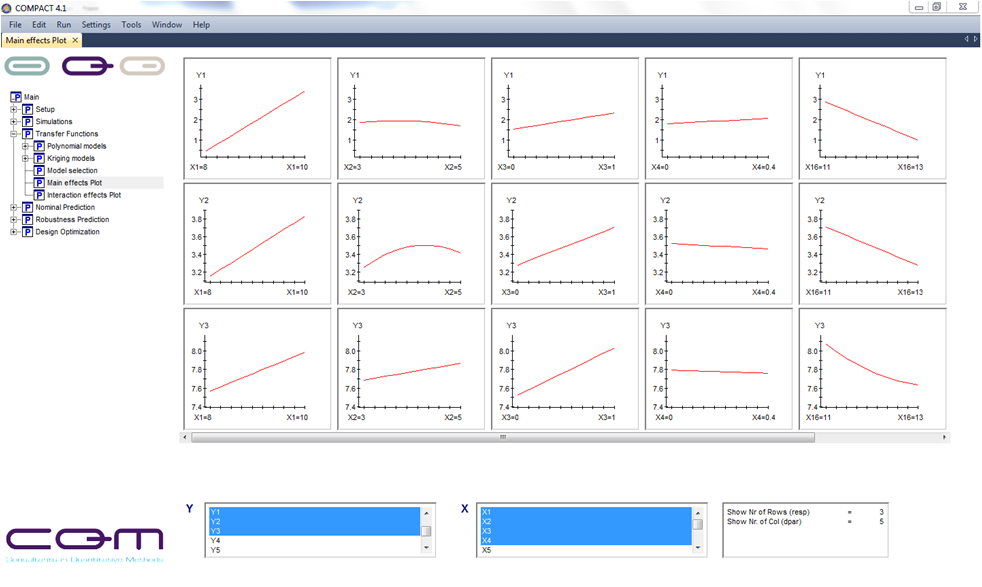
How COMPACT works
COMPACT generates user-friendly surrogate models of the original computer model, with a level of accuracy tailored to the application. These COMPACT models can then be used to predict simulation outcomes, perform robustness analyses, and optimize multiple responses.
COMPACT uses state-of-the-art statistical and optimization techniques to do this. Thanks to its user-friendly interface, all the complex mathematics happens under the hood.
User-friendly software
For more than 10 years, designers and engineers have used COMPACT to identify optimal and robust designs based on their computer models. One example is described in DoCE for an optimal high voltage tube.
