
Across the Dutch railway network, there are roughly 6,000 switches. Of these, around 160 are preventively ground to avoid defects. But is that enough? Should they be ground more often? Or should more switches be added to the grinding programme? To answer these questions, CQM joined the grinding train and investigated the issue.
This year, ProRail is retendering the maintenance of the rails in the Dutch network, including the switches. These components are subject to significant stress caused by wheel–rail interaction: the steel wheels of trains running over the steel tracks.
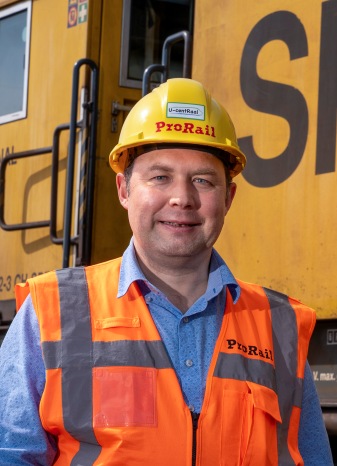
“As trains run over switches, the pressure causes hairline cracks to form on the rail surface,” explains Ivan Shevtsov (photo), Switch System Specialist at ProRail. “We detect these cracks using ultrasonic measurements. If left untreated, and if natural wear isn’t sufficient to remove them, these cracks grow and eventually lead to switch failure. Grinding removes a tiny layer—just a fraction of a millimetre—from the rail, eliminating the cracks. This artificial wear helps prevent failure, at least temporarily.”
The right grinding policy
So how often should switches be preventively ground? At ProRail, this is called cyclical grinding, due to the annual planning cycle. After all, grinding removes material, and the more that’s removed, the shorter the switch’s lifespan. Another key question is whether all switches should be ground.
ProRail defined its current grinding policy in 2017. “We inspect all centrally controlled switches at least once a year using ultrasonic technology,” says Shevtsov. “Of the 6,000 switches, 4,500 are centrally controlled, meaning they’re part of the timetable and therefore frequently used. Heavily loaded switches are inspected more often. From those 4,500, we grind 160 switches preventively on average once a year or every other year. These are switches with a crossing angle of 1:18 or steeper, which makes them both more critical for traffic flow and more expensive to replace. Grinding helps avoid failures that would cause major disruptions. Switches with lower angles are cheaper and faster to repair, so preventive grinding is rarely cost-effective for them.”
Combining data and domain expertise
Grinding is performed overnight by maintenance contractors using specialized grinding trains. With a new tender approaching, Shevtsov and his colleagues wanted to know whether the 2017 policy was still valid or whether improvements could be made. They once again turned to CQM, who had supported the development of the current policy.
“At the time, we analysed the pre-2017 policy, but far less data was available,” says Minou Voortman, project lead at CQM. “This time, we chose to combine data with extensive domain knowledge. We wanted to better understand which parameters truly matter in switch degradation, so we could build a stronger statistical model.”
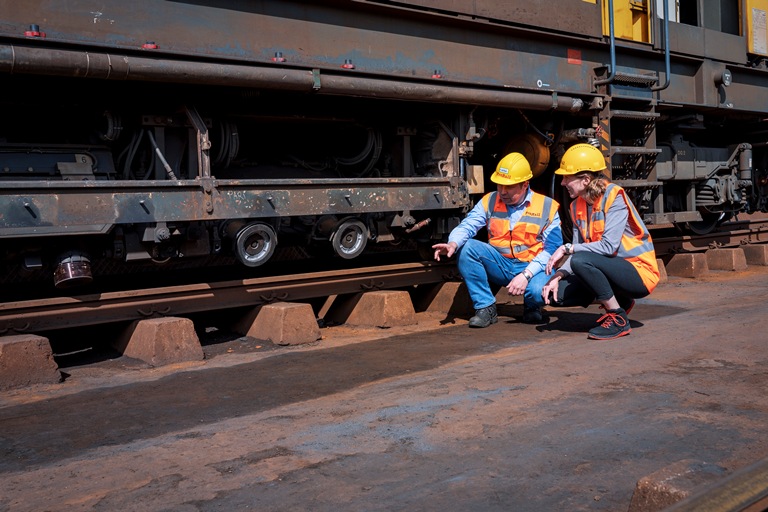
Together with CQM colleague Rutger van Beek, she conducted over ten expert interviews with ProRail specialists, and even rode along on the grinding train. “The experts at ProRail have incredibly deep knowledge of switch behaviour and maintenance. That allowed us to gather a very rich dataset to power the model.”
Recommendations and results
Yet prediction was not the only goal, Rutger explains. “We mainly wanted to understand which variables most strongly influence the risk of defects, and how these relate to whether a switch is ground or not. In addition, we collaborated with ProRail to conduct a cost analysis for two types of switches to determine the financial impact of grinding.”
The project started in spring 2024. In October, Minou and Rutger delivered a comprehensive evaluation report with clear recommendations. “The core question was: is it still the right policy to preventively grind 160 high-angle switches?” says Minou. “The answer is yes. These switches are indeed more prone to failure, and grinding them helps prevent this. The cost analysis also confirms that this is financially efficient. However, for lower-angle switches, preventive grinding does reduce defects but doesn’t lower total cost. In short: our new model confirms that the current policy still holds up. Perhaps not the most dramatic outcome but an important one. It means the decisions made in 2017 were sound, and now we can justify them even better with stronger data.”
Next steps: controlled experiments
“We also asked CQM if the policy could be further improved,” says Shevtsov. “Some lower-angle switches aren’t currently ground preventively, but they’re heavily used, frequently show defects, or are critical for network availability and passenger comfort. So, not just cost-driven factors. Based on CQM’s advice, we’ll start five years of experiments from 2027 to study these cases in more detail.”
Another question is the grinding frequency. Currently, nearly all switches in the programme are ground after a load of 45 mega gross tonnes (MGT), which is calculated based on the number and weight of trains passing over the switch. “We always schedule grinding precisely at that threshold,” says Shevtsov. “But because we’ve been so consistent, we have no data on what happens if you grind earlier - say at 15 MGT - or later, at 60 MGT. CQM’s model can’t answer that either, because the data simply doesn’t exist. So again, the recommendation is to run experiments to generate new data points for broader prediction capabilities.”
High impact, behind the scenes
Minou and Rutger are currently working on a smart, well-balanced experimental design to help ProRail test these new insights in the coming years. These types of projects are rarely visible to the public but they have major societal impact.
“When you’re sitting on a train, you have no idea how much work goes on behind the scenes to keep it running,” Minou reflects. “We’re very grateful that the ProRail specialists shared their knowledge with us. Riding along on the grinding train and seeing a switch up close was invaluable.”
Shevtsov adds: “CQM quickly mastered the complexity of the problem. The data analysis was both fast and thoughtful. A top team.”
Curious what data-driven maintenance could mean for your organization?
Get in touch with CQM to explore the possibilities.
Standing in the main photo from left to right: Ivan Shevtsov | Switch System Specialist – ProRail, Minou Voortman | Senior Consultant – CQM, Jeroen Wegdam | Switch System Specialist – ProRail, and kneeling: Rutger van Beek | Junior Consultant – CQM.
Credits: EvE Creations.