
17/03/2026
The strategic challenge
Warehouses are under increasing pressure. Volumes fluctuate, labor is scarce, and service levels must remain high. At the same time, costs need to stay under control.
Many organizations look to automation, new software, or Artificial Intelligence (AI) for solutions. But the reality is often more complex. A warehouse operation is not a collection of isolated processes—it is an interconnected system in which every decision affects something else.
And that is often where the real challenge lies.
Warehouse optimization is more complex than it seems
At CQM, we deliberately invest in domain knowledge. One example is our internal Smart Warehousing domain training.
The training is led by colleagues who have spent years optimizing warehouse operations. They share their practical experience with fellow consultants, helping them build a deep understanding of warehouse processes, terminology, and real-world operational challenges.
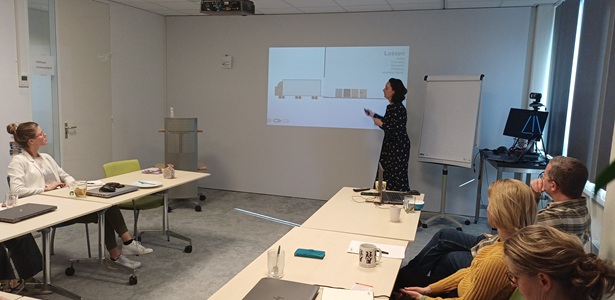
One lesson consistently stands out: the complexity of warehouse operations is often underestimated.
Processes continuously influence one another. What appears to be the optimal solution for one process may have unintended consequences elsewhere.
Take slotting, for example—the assignment of products to picking locations. A seemingly small change can significantly affect picking routes, lead times, and congestion in busy aisles. The same applies to decisions about order batching, pick zones, or picking sequences. Organizing products from heavy to light, or according to store sequence, may improve roll container loading while simultaneously increasing walking distances or reducing labor efficiency.
Adding to the complexity, no two warehouses are the same. Every operation has its own layout, processes, constraints, and objectives. That is why optimization must always be approached within the context of the specific system.
Models versus reality
When modeling warehouse operations, we combine operational expertise with data from systems such as a Warehouse Management System (WMS). These data reveal, for example, how picking times actually vary by order, employee, or time of day.
In practice, picking performance is influenced by many factors, including:
- Product characteristics
- Employee experience
- Traffic and congestion in warehouse aisles
- Differences between shifts
- Day-to-day operational variation
A model that ignores this context can produce a distorted view of what is truly optimal. That is why understanding the operation is essential for developing effective optimization models.
AI, Optimization, and domain expertise
The growing interest in AI within the logistics sector makes this even more relevant. AI can be a valuable addition to warehouse operations, but without a thorough understanding of processes and deep domain expertise, its full potential will never be realized.
That is why CQM combines Optimization, data analysis, and a deep understanding of warehouse operations. During the Smart Warehousing training, consultants not only learn about the mathematical models and algorithms we develop for clients, but also about the realities of day-to-day warehouse operations.
As part of the second training module, participants visit a warehouse in Tilburg. Seeing the operation firsthand makes it clear where variation, constraints, and dependencies actually arise. This practical experience is essential for interpreting data correctly and building models that perform not only in theory, but also in practice.
Why CQM invests in domain knowledge
At CQM, we believe that effective models start with a deep understanding of the operation. That is why we deliberately invest in domain training for our consultants.
Through our Smart Warehousing program, colleagues deepen their knowledge of warehouse processes, terminology, and real-life logistics challenges.
This combination of mathematical modeling and in-depth process knowledge enables us to develop solutions that are not only theoretically optimal but also deliver measurable results in practice.
Looking ahead
Smart Warehousing is about much more than algorithms or data.
It is about understanding a complex system of processes, people, and operational constraints.
Organizations that truly understand that system can improve it. And that is where the real strength of data-driven warehouse optimization lies.
Curious how this applies to your warehouse?
We would be happy to discuss the interconnected challenges within your warehouse operation—from data to decision-making. Feel free to get in touch with Britt or Geert.