
25/06/2026
Why do some organizations repeatedly face recalls, overruns and inefficiencies - while others succeed in delivering high-quality products time and again?
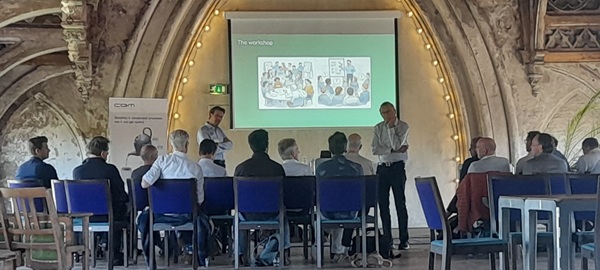
This question formed the starting point of a recent round table in Utrecht, where innovation and R&D leaders from companies such as Lely, Gazelle, Philips, ThermoFisher, ASML, FrieslandCampina, JDE, Bosch and Veco came together at the inspiring Metaal Kathedraal to exchange experiences and learn from each other.
Throughout the afternoon, participants explored what it takes to make data-driven innovation work in practice: identifying risks earlier, making better decisions under uncertainty and creating stronger connections between technical choices and business outcomes.
Why innovation capabilities matter
The afternoon opened with a keynote by Gerard Majoor titled Innovation Excellence: Essential for Value, Elusive in Practice. Drawing on years of experience, he shared concrete, hands-on examples - from projects that went wrong to organizations that consistently get it right.
The question above captured the essence of his story.
The difference, he argued, is rarely genius. It is about capabilities.
"In innovation, most problems are not solved too late - they are discovered too late."
Gerard illustrated how leading organizations approach this in practice. They invest in exploring uncertainties earlier in the process - shifting key decisions, risk identification and learning to the front. They move away from trial-and-error and build a deeper, causal understanding of how their product works. Decisions are increasingly supported by data, simulations and explicit assumptions, rather than hierarchy or intuition alone.
At the same time, they actively balance trade-offs between customer value, technical feasibility and business impact - and rely on integrated teams instead of functional silos. Crucially, these elements are not applied in isolation. Real progress comes from developing these capabilities in a balanced and connected way across the entire product development process.
Beyond methods: decision-making under uncertainty
In the breakout sessions that followed, participants reflected on how these ideas translate to their own organizations. Using a maturity matrix as a starting point, conversations quickly revealed a wide range of realities. Some organizations are still building their foundations, while others are highly structured - sometimes even to the point where structure starts to limit flexibility.
One recurring insight was:
"Higher maturity is not always better - the right balance is."
The real value of the matrix was not in the scoring itself, but in the conversations it enabled - making trade-offs explicit and helping to align perspectives within organizations.
Across both the breakout discussions and the plenary reflection, a clear pattern started to emerge. The challenge of data-driven innovation is rarely about the availability of tools or data. Most organizations already have access to models, analyses and technical expertise.
The real difficulty lies in how organizations work. Engineers often recognize the importance of exploring uncertainties early, but aligning this with business priorities such as time-to-market or commercial pressure is where complexity arises. It requires leadership, translation between perspectives and the ability to connect technical depth with business impact.
As one participant summarized:
"The real challenge is not the tools, but how we make decisions together."
Learning across industries
The afternoon ended with informal conversations over drinks, where participants continued exchanging experiences and perspectives. There was a clear sense that, although contexts differ, many organizations are navigating similar challenges - and can learn a great deal from each other.
What stood out most was the openness to share and learn across industries:
- "It's great to connect with R&D managers from completely different industries and learn from each other."
- "We all face similar challenges, but don't often get the chance to openly discuss them."
- "It's inspiring to hear how far others are - and what it has brought them."
- "The maturity matrix helps me make my ambitions much more concrete. I take this home to discuss further within my organization."
From ambition to action
Moving from ambition to action requires more than intent.
It requires building the capabilities - and the organization - to make data-driven innovation truly work in practice.
Interested in continuing the conversation or exploring your organization's maturity?
Feel free to reach out to Peter Stehouwer or Emy Hermens.