
04/06/2026
Schools collect increasing amounts of data on student attendance and absenteeism.
But what questions can that data actually answer—and which questions can't it?
That question was at the heart of School InSight, a collaborative project involving Brainport Development, Brainport voor Elkaar, Berkenschutse, Tilburg University, RSV PVO, and several schools in the Brainport region. Organizations including ASML and the Municipality of Eindhoven also contributed through advisory sessions and the project's final presentation.
On behalf of CQM, Heleen Muijlwijk participated in the project and presented the initial findings during the Social Innovation Talks organized by Brainport voor Elkaar at the High Tech Campus Eindhoven.
The starting point was familiar. Schools have access to plenty of data, but often lack the insights, structure, and practical tools to turn it into better decisions. As a result, the initial request from the field seemed straightforward:
"Can't we just build a dashboard?"
First understand the question you're trying to answer
In practice, the challenge proved to be much more complex.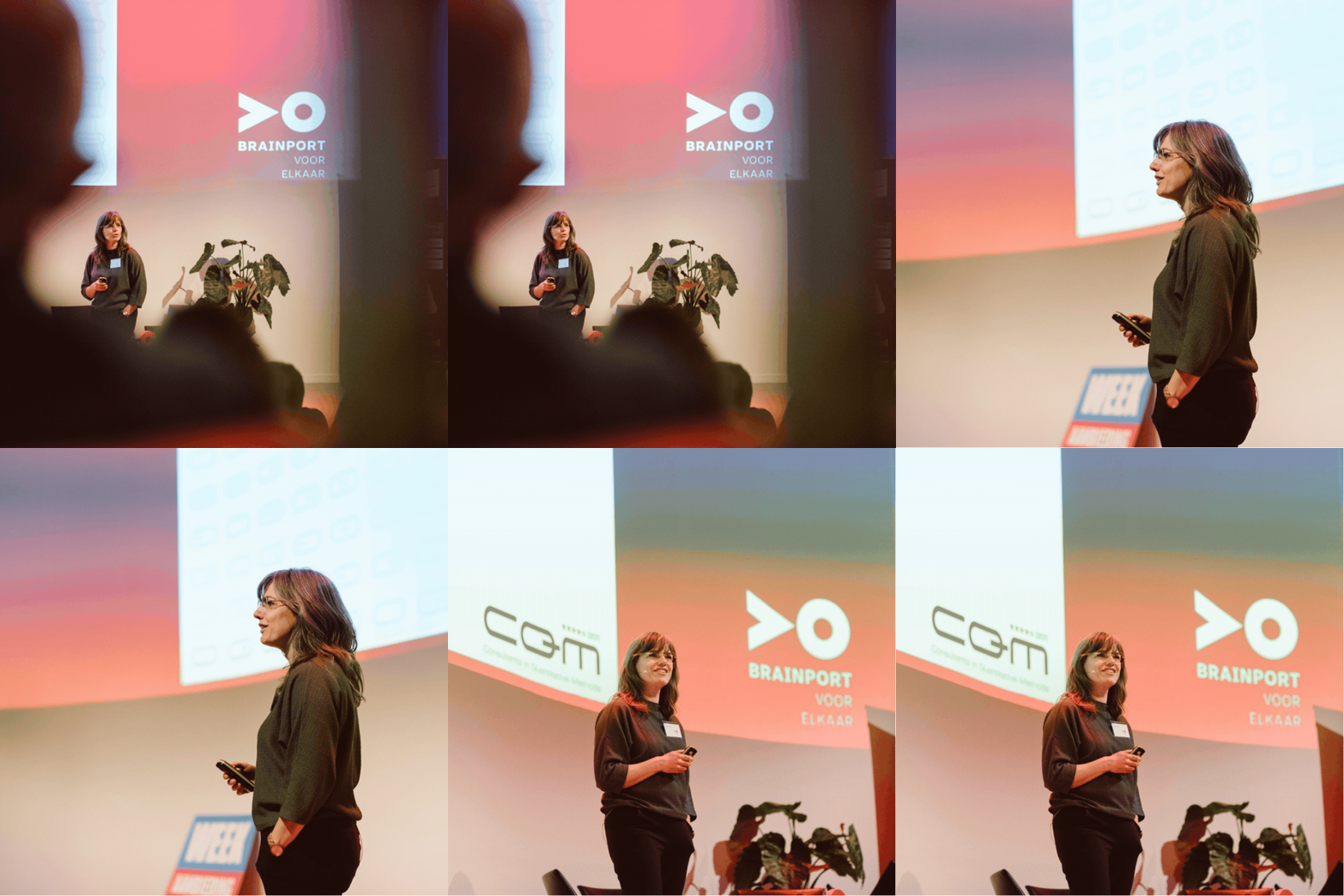
Because what question are you actually trying to answer?
- Are you trying to identify patterns?
- Predict absenteeism?
- Evaluate the effectiveness of interventions, such as mentor meetings?
- Or support better conversations with students, parents, and social support professionals?
Each of these questions requires different types of information. Sometimes you need data at the individual student level, sometimes data collected over longer periods, and sometimes context that you may not even want to record because of privacy or ethical considerations.
"There is no one-dashboard-fits-all solution," says Heleen. "This project clearly demonstrates that data is often only the tip of the iceberg. It certainly tells part of the story, but there is always more beneath the surface. That's why it's essential to keep listening, observing, and asking questions."
Another important theme was data quality and interpretation. Attendance records, for example, often contain inconsistencies—not because teachers are careless, but because their daily priorities naturally lie elsewhere. And once predictive models enter the picture, new questions arise about privacy, ethics, and the risk of unintended profiling.
Data as a tool, not the final answer
Within the project, CQM worked together with schools to determine which questions could genuinely be answered using data.
Some insights could be supported relatively well, including:
- Differences between grade levels
- Relationships between forgotten homework and absenteeism
- Patterns linking attendance and academic performance
Other questions, however, required human interpretation and dialogue:
- When does absenteeism become a real concern?
- What roles do parents, teachers, and student support teams play?
- How can organizations prevent predictive models from leading to unintended profiling?
This nuance became one of the project's greatest strengths. Not everything that can be measured should automatically drive decisions.
At the same time, the project demonstrated that data can help organizations move beyond anecdotal observations. By revealing patterns, data provides stronger evidence for meaningful conversations, interventions, and policy decisions.
Collaboration between education, science, and industry
Brainport voor Elkaar invited CQM to present the project's findings during the Social Innovation Talks as an example of what can be achieved when businesses and public organizations work together. More specifically, the presentation highlighted how analytical expertise can contribute to addressing societal challenges.
The event also hosted the Brainport Eindhoven Social Innovation Hackathon, where professionals and students from industry and education collaborated on regional social challenges.
As part of CQM's 1% Pledge, two CQM colleagues participated in multidisciplinary teams. Once again, analytical thinking, collaboration, and practical applicability were central themes.
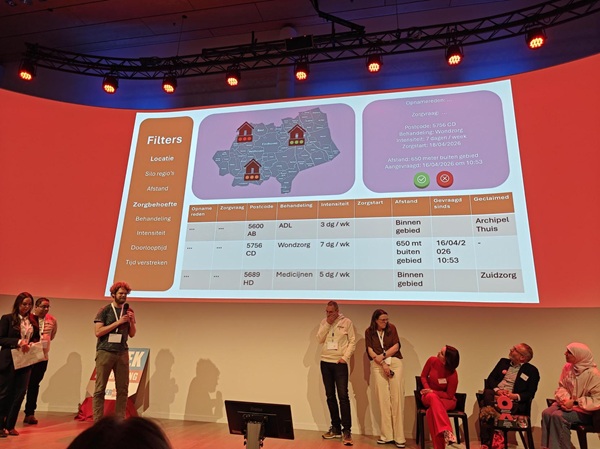
One colleague worked with Archipel on the challenge "Right care, right place," exploring how healthcare requests could be matched more effectively with available care capacity. The team developed ideas around filtering, regional coordination, and improving insight into care requests and available capacity.
Another colleague worked with Super Sociaal in Helmond, a supermarket initiative supporting low-income households. The team developed an interactive map using data from Statistics Netherlands (CBS) and Super Sociaal, showing for each neighborhood how many eligible households actually make use of the available support.
In both projects, the greatest value ultimately came not from dashboards or analyses alone, but from structuring the underlying challenge, improving processes, and connecting different perspectives. During the Super Sociaal challenge, for example, the hackathon directly led to concrete ideas for centralizing data and reducing duplicate registrations.
The role of data-driven insights in societal challenges
For CQM, this project demonstrates that Optimization, Industrial Statistics, and domain knowledge are valuable not only in manufacturing or logistics, but also in societal challenges where nuance, collaboration, and the human perspective are just as important as the analysis itself.
That is where we see the real value of analytical expertise and data: sometimes to find answers, but often to facilitate better conversations and create a deeper understanding of the decisions that truly matter.
Especially in societal challenges, value is created not by collecting more data alone, but by carefully connecting data with the stories behind it and the different interests involved.
Interested in learning more?
Would you like to learn more about social innovation and the role of data in addressing societal challenges?
Feel free to contact Heleen Muijlwijk. She would be happy to share more about the insights from School InSight and discuss how analytical expertise can contribute to complex societal challenges.
Looking for a speaker for your event, knowledge session, or inspiration day?
Visit our speakers page and discover how CQM translates complex challenges into practical insights for executives, professionals, and organizations.
Header image by: Tyli Jura, Pixabay.