
Read more
Date: 16 Jan 2025

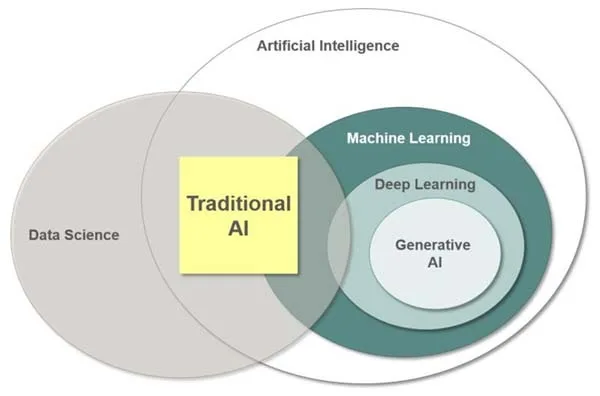
Fig. 1: Artificial Intelligence is much more than generative AI.
The buzz around generative AI - such as ChatGPT - is impossible to ignore. Whether at work or in daily life, everyone is discussing its capabilities: generating text, writing code, or summarizing large volumes of information. In many cases, this saves time. But the most pressing challenges organizations face - such as optimizing supply chain processes - cannot be solved with generative AI.
This is where traditional AI comes into play. It’s a form of technology that has been used successfully in industry for decades, delivering measurable, reliable outcomes.
Generative AI (Gen AI) refers to AI that creates new content. It’s trained on vast datasets and uses that knowledge to generate text, images, or other outputs. Think of tools like ChatGPT, capable of composing complex sentences or proposing creative solutions. Yet this technology comes with limitations. One of the most discussed issues is “hallucination”; the generation of incorrect or even fabricated information. This makes Gen AI less suited to contexts where accuracy and reliability are critical, such as business decision-making.
Traditional AI (Trad AI), by contrast, focuses on predictive and prescriptive analytics. It uses advanced statistics, Machine Learning, and mathematical optimization to solve concrete problems. This technology is applied in core operational processes such as demand forecasting, route optimization, and inventory management. Built on hard data, Trad AI delivers robust, repeatable, and trustworthy insights. Exactly what businesses need to support strategic and operational decisions.
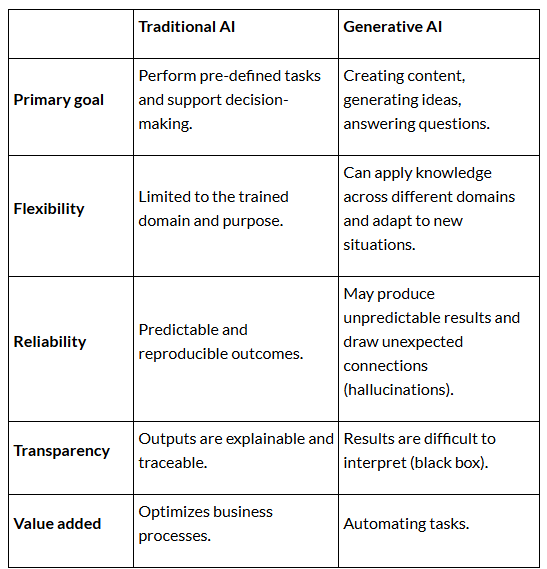
Generative AI absolutely has its place, but it’s no silver bullet. In practice, it works best in secondary processes: aiding communication, supporting ideation, or speeding up creative workflows. But when it comes to mission-critical business processes, where consistency and accuracy are non-negotiable, Gen AI quickly reaches its limits. An error in prediction or a misjudged recommendation can have serious consequences.
Imagine you are running a production plant. You need to decide what to produce, when to switch lines, and how to respond to disruptions. There’s no room here for “hallucinations.” You need models that are grounded in real data and use mathematical optimization. One example is the work we did with Fibrant, a case that perfectly illustrates the strengths of traditional AI.

Fig. 2: The supply chain of physical goods—from product development through production, warehousing, and transport.
Traditional AI plays a crucial role in primary supply chain operations. At CQM, we’ve been using Data Science to enhance business performance for decades. Below are a few practical examples of how traditional AI adds real value:
Case: Smart and connected shavers for Philips
Smart integration: By linking an app to a physical shaver, users receive real-time advice for optimal use.
Value: Increased customer satisfaction and brand loyalty.
Case: Fujifilm’s production planning tool
Minimizing cutting waste: Mathematical optimization reduces material waste, while the planning system improves the coordination of machines and staff.
Value: Significant financial and operational gains, combined with a more sustainable and efficient production process.
Case: Smart Logistics at Albert Heijn
Improved productivity: Smart container loading and pick order generation reduce time and travel within the warehouse.
Value: Cost savings, greater efficiency, and deeper insight into productivity drivers.
Case: Complex planning at Den Hartogh Liquid Logistics
Intermodal transport optimization: A bespoke APS system uses prescriptive analytics to optimize the movement of chemical tanks across Europe, factoring in transport modes, cleaning, repositioning, and repair.
Value: Enhanced planning, better asset utilization, increased productivity, and more proactive strategic decision-making in a complex logistics landscape.
While traditional AI may not generate headlines, these examples show how it consistently delivers value to companies that want to thrive - not just survive - in their markets.
What truly makes traditional AI powerful is the combination of human insight with technical expertise, process knowledge, and deep domain understanding. At CQM, this integrated approach consistently proves its value. Technology alone isn’t enough. Without understanding the problem context, you won’t unlock its full potential.
Our working method brings these elements together (as also explained in the article “Smart warehousing doesn’t have to be expensive thanks to AI” on Logistiek.nl). By collaborating closely with our clients, we develop solutions that are not only technically sound, but also practical and effective.
Generative and traditional AI each have their place. Generative AI is a powerful tool for creative and supportive tasks, while traditional AI is the key to solving concrete business challenges. For organizations seeking real impact, the priority is to use the right technology for the right task. In the end, it’s not about what’s trendy. It’s about what delivers tangible results.
For over 45 years, CQM has been applying traditional AI to help organizations grow. From idea to implementation, from change to long-term support; we create lasting value for processes, culture, and systems.
Would you also like to stay up to date with the latest news from CQM? Follow us on LinkedIn

