
Planning for collecting sugar beets becomes faster and more consistent
Most sugar beet growers prefer their harvest to be collected by the corporation in November. But not all growers in the Netherlands can be served simultaneously in that one month. So shifting to other, less preferred months is necessary. How do you ensure that this happens as consistently and fairly as possible? CQM developed an algorithm for it.
The season for harvesting sugar beets in the Netherlands runs from September through January. Growers must indicate their preferred delivery period to the corporation in May. This corporation is the Dutch Cosun. The beets of approximately 8,000 member farmers are collected by Cosun Beet Company using machines and transported for processing in large sugar factories in Dinteloord (North Brabant) and Hoogkerk (Groningen). Five planners at Cosun Beet Company determine the logistics planning for deliveries. A planning that is more complex than it seems.
Preference
“The grower’s preferred month is the starting point for our planning,” says Manous Koopmans, Innovation Manager Agro Logistics at Cosun Beet Company. “In a normal season, most growers prefer to harvest their beets around mid-November. At that point, they are fully grown and yield the highest sugar content. Growers therefore prefer us to collect the beets at that time. But if we had to do this for all growers at the same time, it would not be logistically feasible. Each year we transport on average 8 million gross tons of sugar beets. During the campaign, this amounts to approximately 1,100 loads per factory every 24 hours. So the volumes are enormous. That is why we need to spread the loading over the campaign months from September through January. This means that not every grower’s preferred month can be honored. Instead of November, they may be scheduled in October, for example. But harvesting earlier means slightly smaller beets and potentially lower sugar yield. Collecting later means the harvested beets remain stored longer at the grower, which can also negatively affect both sugar yield and tonnage.”

Left: Kees Langebeeke, Manager Agro Logistiek - Cosun Beet Company and
right: Manous Koopmans, Innovation Manager Agro Logistics - Cosun Beet Company
Fair
Cosun Beet Company therefore applies a payment structure with early and late delivery bonuses, compensating growers for earlier or later collection. Koopmans: “Through compensation, we ensure that all growers receive an equivalent payment for their beets. Nevertheless, growers prefer their preferred month to be respected, for example because it fits best into their own seasonal planning. If their preference is repeatedly not honored, this can be perceived as unfair. We have taken this into account in our planning for years. We have rules to prevent this ‘unfairness’ as much as possible.”
Complex
Although the rules are well thought out, it is a major puzzle every year for the planners at Cosun Beet Company to create a consistent plan. It is much more complicated than you might think, according to Koopmans: “If, due to an overloaded month, you have to shift one large grower by a month, this may mean that you also have to assign five smaller growers to other months, which again affects the volumes and number of growers in those months, and so on. In addition, there are growers who, due to soil quality in their region or other circumstances, want to harvest earlier or later than November, or growers who want to deliver their beets at multiple moments during the season. We also look at the allocation per grower over the past five years: how often has the grower’s preferred month been honored or not? Another important factor is the order in which our loading units collect the beets from growers across our more than 30 regions. This happens in multiple rounds each campaign month. We take all of this into account. Until last year, we did the planning manually in Excel. A very time-consuming and not future-proof task. That is why we asked CQM to develop an algorithm for this.”
From complex puzzle to fair planning
From CQM, consultants Daniëlle Hendriksen and Jordi Zomer worked closely with the Agro Logistics team of Cosun Beet Company. Daniëlle: “At CQM, we usually work on optimizing processes. But because Cosun Beet Company can never satisfy all growers’ wishes, not everyone can be fully satisfied in the planning. What we can do is build an efficient and robust algorithm, so that the rules are applied as well and as consistently as possible, and as few growers as possible are disappointed.” CQM started in February 2025 with prioritizing and refining the rules and translating them into parameters that the algorithm understands. Daniëlle: “For each grower, we input the basic data: the expected volume of beets based on hectares, how often the grower wants to deliver during the campaign, their preferred month for collection, and their score over the past five years. The model starts with a plan in which everyone is assigned according to their preferred delivery month, but which is not feasible. The algorithm then systematically applies the rules to shift growers to other months, with the goal of finding a solution that best matches the capacity requirements.” In March 2025, CQM and Agro Logistics employees tested and refined the algorithm. In April and May, the algorithm was applied for the first time in planning the new beet campaign.
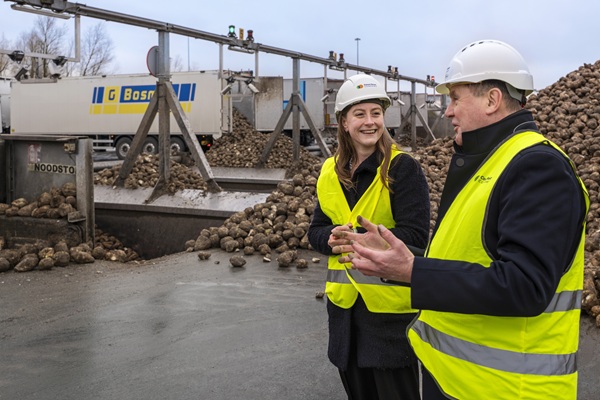
Daniëlle Hendriksen (left) and Kees Langebeeke (right) during the unloading of sugar beets at the Cosun site in Dinteloord.
Time savings
What has the new algorithm delivered for Cosun Beet Company? Koopmans: “First of all, time savings. The algorithm calculates the best solution in just a few seconds, which used to take us several weeks manually. We still need to prepare the input and fine-tune afterwards. But we now need two to three weeks, whereas we previously spent five to six weeks on planning. These time savings are important. Growers would like to indicate their preferred month as late as possible, because then they better understand how their crop is developing. Thanks to the algorithm, we can plan a few weeks later, which benefits both us and our members.” But has the planning also become more consistent? “In essence, yes,” says Koopmans. “The rules are always applied in the same way by the algorithm and are no longer influenced by the interpretation of individual planners. At the same time, we still have room to adjust the preliminary planning from the algorithm based on current considerations towards a final plan.” According to Koopmans, Cosun Beet Company now has a mature planning mechanism that can be further improved in the coming years: “CQM has done an excellent job. They quickly understood our domain and encouraged us to think even more critically about the planning process. Based on the first application of this algorithm, I think the planning is already about 80% of the desired quality level. I am convinced that, through experience, we will continue planning faster and more consistently. And therefore to increasing satisfaction of our growers.”
Also facing complex planning challenges under capacity pressure?
We help you move towards a robust and explainable approach. Schedule a conversation with Daniëlle or Jordi.
In the main image at the top, from left to right: Kees Langebeeke (Manager Agro Logistics – Cosun Beet Company), Manous Koopmans (Innovation Manager Agro Logistics – Cosun Beet Company), Jordi Zomer (Consultant – CQM), and Daniëlle Hendriksen (Junior Consultant – CQM).
Foto credits: EvE Creations.