How do you determine the optimal sales strategy for scarce capacity in an energy market that is constantly changing? And how do you know whether you are leaving value on the table?
For BritNed, this is a strategic question. Through auctions, the company determines how the capacity of the electricity interconnector between the United Kingdom and the Netherlands is marketed. CQM enhanced the SPLIT model that BritNed uses to support these decisions. The result: better insight into the value of different sales strategies and stronger data-driven decision-making.
BritNed's electricity interconnector is 260 kilometers long and has been transporting electricity between the United Kingdom and the Netherlands for more than 15 years. With a capacity of 1,000 megawatts, it can supply around 2 million households. BritNed is a joint venture between National Grid in the UK and TenneT in the Netherlands. The two partners share the profits generated by the interconnector.
 "We do not buy and sell electricity ourselves," explains Jon Cole, Customer and Markets Manager at BritNed (photo). "We manage the cable and sell capacity to energy traders to flow electricity."
The energy market in which BritNed operates is highly dynamic and strongly influenced by external factors such as weather conditions and price differences between countries.
"On a windy day in the UK, for example, electricity generated by our wind farms may be exported to the Netherlands," says Cole. "But during the summer, when the Netherlands has a surplus of solar energy from its many solar panels, the flow can reverse."
Product mix
Energy traders, BritNed's customers, want to buy electricity as cheaply as possible. For BritNed, the challenge is to market the interconnector capacity as effectively as possible. This is done throughout the year via an auction process in which BritNed offers a mix of products that differ in volume and duration.
Cole explains: "We determine that mix ourselves based on our expectations regarding demand and the value of the different products. We offer a range of products, from annual, quarterly and monthly contracts to day-ahead products. The latter are particularly popular because traders have greater price certainty when buying and selling closer to delivery."
Determining the right mix is complex. Not only because of market dynamics, but also because it is difficult to assess how effective a chosen strategy actually is. Without insight into the theoretical optimum, it remains unclear whether value is being missed and where adjustments are needed.
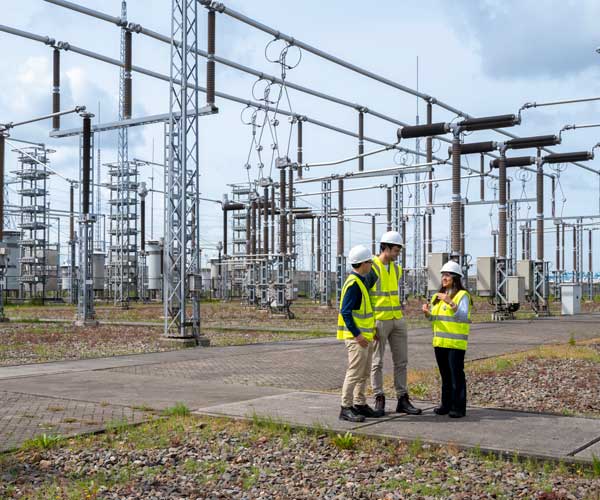
Pictured, from left to right: Rutger van Beek and Joost van Sambeeck (CQM) with Fatima Kheiri (BritNed). All three were part of the project team that worked on the further development of SPLIT.
SPLIT
The right product mix is strategically important to BritNed because it influences both profitability and certainty. Longer-term products, such as annual and quarterly contracts, are sold much earlier and therefore provide more predictable revenues.
To support these decisions, BritNed developed its own model many years ago: SPLIT. The model combines price forecasts with BritNed's business constraints and calculates how available capacity should be "split" across the different products.
Cole: "The model generates a value forecast for each product type and determines how we should allocate our capacity and when we should offer specific products. The result is an auction calendar that maximizes expected revenue based on the information available at the time.
However, the model was not very user-friendly and was written in Matlab, a programming language that only one person within our organization could work with. That created a degree of operational risk. In addition, the existing setup made it difficult to run scenarios quickly and to properly substantiate decisions. That is why we asked CQM to conduct a model review."
Further development of SPLIT
"BritNed initially asked CQM to migrate the existing SPLIT model from Matlab to Python," says Arno van den Eijnden, Senior Consultant at CQM. "By doing so, the model became less dependent on a single specialist and more accessible across the organization. In the next phase, we further enhanced SPLIT step by step, including a user-friendly interface and faster scenario analysis capabilities. The model evolved from a specialist calculation tool into a practical decision-support instrument."
For this development phase, BritNed and CQM worked together through a monthly fixed-price arrangement. This provided enough flexibility to incorporate new insights and improvements while continuously focusing on the enhancements that delivered the greatest value.
Key improvements
The development program ran from spring 2024 until mid-2025. By the end of the project, the key improvements had been implemented.
 Van den Eijnden: "Thanks to the new user interface and configurable parameters, BritNed planners can now evaluate scenarios with different product portfolios much more easily. We also migrated the model to the cloud, allowing people to access and use it from anywhere.
Scenario calculations are now completed in minutes rather than hours because much of the manual work has been automated. As a result, the risk of human error has also been reduced."
Pictured: Data Analyst Fatima Kheiri (BritNed) with a cross-section of the subsea high-voltage cable connecting the Netherlands and Great Britain.
Better decisions
For Jon Cole, the most important improvement is that SPLIT now looks both forward and backward.
"The enhanced model now consists of two components: pre-auction and post-auction. The pre-auction model determines the best product mix for the upcoming auction. We run this every month. After the auction, the post-auction model analyses what could have happened under optimal conditions. The model explicitly shows what we achieved and what we could have achieved. This makes it immediately clear where value is being left on the table and which decisions deserve attention. It gives us a very concrete view of our performance, not just for a single auction month, but across an entire year. Looking at 2025, we found that we achieved approximately 70% of the theoretical optimum.
Those insights translate directly into decision-making. One of the key conclusions was that we should sell less capacity through annual products and more through quarterly products. We implemented that change immediately, and we can already see the impact on our results. The new SPLIT model has also become an excellent tool for strategic analysis and reporting to management and the Board. We can now explain our decisions much more clearly and demonstrate their impact. Where experience and intuition once played a major role, we now have a solid data-driven foundation."
The speed and reliability of decision-making have also improved significantly. Scenarios that previously took hours to calculate are now available within minutes.
The enhanced SPLIT model now supports BritNed in a concrete strategic decision: which product mix delivers the highest revenue under current market conditions? Where decisions were previously driven largely by experience, there is now a data-driven foundation that provides insight into performance, improvement potential and concrete actions.
"Just really good"
The largest improvements to SPLIT have now been completed. As a result, the project has transitioned into a standard support agreement.
Jon Cole also looks back positively on the collaboration:
"I am extremely impressed by CQM's performance. They bring a tremendous amount of knowledge, ideas, empathy and professionalism. Just really good."
Ready to make better strategic decisions with data?
Curious how data and optimization can help your organization make better decisions? We'd be happy to explore the possibilities with you.
Get in touch with Arno, Joost or Rutger.